Dinner tonight was quieter than usual.
We ate on the porch, mostly ignoring the mosquitoes buzzing around us and ate the green beans, rice, and stuffed peppers in the growing darkness. Sometimes my host Dad tried to break the silence with something encouraging.
"It will be hotter tomorrow" he said "but your going by the sea, Kyla, that will be nice."
I agreed, but my heart wasn't in it. A few hours before I had learned I was going to be moving to a little town six hours away I hadn't heard of. "Balikeser" it was called
With a record breaking total of 13 hours notice, I was told that a family vacationing in Balikeser wanted to host me. Ocean, Beaches, historical sites. It sounds nice, but it almost feels like a whole different exchange. I will leave the wonderful support network I have created for myself here and make another life far away from my rotary club, friends, and past host families. Luckily, some things will still be the same. I've been told the culture is a bit different, but I will be familiar with the basics, especially the language. Not to mention I already have one contact: A friend of a friend who is an English teacher there.
In a way I feel happy that I feel sad. To me, that means I have made a real, meaningful life for myself in Edirne and I have something substantial to miss: The park I did my homework sometimes, the walk from school past my old host families house to my new one, and the little shops where the shopkeepers know my name, and speak a little more slowly so I will understand; these things will always be a part of who I am. Hopefully in two short months Balikeser can also become a part of this.
Friday, June 8, 2012


Wednesday, May 23, 2012
My legs were already begining to ache when we decided not to go to the bazaar. My friend Hung Yu and I had decided to explore Konya in out free time, but I was becoming nervous from the narrow winding city roads that threatened to swallow us up, never to return to the hotel.
"Maybe we chould go back" one of us suggested, but the thought of spending the rest of the day at the hotel wasn't appealing to either of us, so Hung Yu checked her guide book and suggested we check out a little church a half hour a way by bus.
Of course, this plan had draw backs of it's own. We were unfamiliar with the bus system, and we were worried the busses might even stop before we got back, but it turned out using the busses was very easy. There was a prominitely posted bus schedule and we were easily able to buy a two-use bus card at a nearby kiosk. So we waited for bus 64 to Sille
Once we had all made it on, the bus winded through the city until we had left the crowded sprawl of small shops behind and had entered an expanse of dusty grass spotted with a few resiliant shrubs and the occasional tree.
"How will we know when our stop is?" I asked Hung Yu
"It's the last one" she replied
Finally I saw a minaret in the distance and a small village came into view. Our bus pulled up the the covered bus stop, the most modern looking thing in sight.
The church was visible from the bus stop, but as it turns out it was under restoration, so we climbed up to a small castle nearby, passing an old graveyard from Ottoman times on our way.
We still had some time until the bus came back, so Hung Yu suggested we walk through the village, towards some caves we had seen in the nearby hills.
The village was peaceful. A few children chased each other and two women in colorful headscarves made there way slowly down the main road.
We turned right at the mosque, and climbed a little ways to find the caves, but it was definately worth it. Although, at the time we didn't know any details about their history, it was clear the natural rock had been modified for use by humans. Some caves were seperated into small rooms, and there were recesses in the rock I imagined could have been used for storage or as a fire pit.
While exploring, we ran into two local boys , Ahmet and Mehmet, who gave us their highly imaginative version of what had gone down in the caves, which included lots of torture and a lion.
They were disappointed when, ultimately we refused to pay them for it.
We left Sille after that, but the mystery of the caves continued to haunt me. After dinner, I tried to find information about them online, but there was very little information about Sille, and even less about the caves.
Despite this setback, I was determined to learn the history of the caves, so the next day I approached our tour guide and showed her the pictures I had taken.
As it turns out, people have been living in those caves for eight thousand years! The first peoples settled in around six thousand BCE and since then those caves have been used as housing, storage, and even a monastary! Stone from the caves was used to to make some of the buildings we were to tour later that day.
The city also had an interesting history , it had been home to Greek and Turkish Christians up until the population exchanges of nineteen tweny two. Before that, the population had been protected by the poet Mevlana Rumi, and the people for many years were charged with maintaining his tomb. The village was also a stop along the silk road.
Needless to say, I think our detour turned out very well. Just goes to show, you never know how what you will find until you try a detour!
Saturday, May 5, 2012
First thing first.... It's my birthday! As I say every year, I am officially old! (well... I think I said that last year, anyways). It's still early , but so far to celebrate I have confirmed the date of my skype interview for the pre-college program I hope to enroll in next year and looked up some interview tips. Also, homemade lemonade for breakfast. yum. My seventeenth year is off to a great start!
I get the distinct impression I will be going out with my host sister Cemre to celebrate. It sounds like she's inviting some people from school along, so we'll see how this goes. Knowing me, I would just as soon be curled up with a good book, but I'm sure I'll have a good time either way.
I laughed today looking at the Facebook greetings I'm getting. It seems like Turks have very specific greeting for everything. In English, there are a whole variety of things you say when welcoming someone to your home: "Welcome, come in, nice to see you"; when you give someone a meal: "enjoy your meal, Bon appetite"; and when someone is ill... well you get my drift. In Turkish, there is a single thing you say for each of these situations: Hos Geldin, Afiyet Olsun, and Gecmis olsun respecively. There are many more examples of this. However, for birthdays this is quite the opposite. In English we are pretty much limited to "Happy Birthday" and in Turkish there is no set greeting! This explains the "Happy New Years" the president of my rotary club posted (in English). In Turkish, one of the things you might say for birthdays is Mutlu yillar, which translates to Happy New Year! It actually makes a lot of sense when you think about it.
--- On a side note ---
I am entering a contest to try and win a senior photo session from the fabulous Becky Birch-Gutierrez. If you could click and vote I would appreciate it :-)
I get the distinct impression I will be going out with my host sister Cemre to celebrate. It sounds like she's inviting some people from school along, so we'll see how this goes. Knowing me, I would just as soon be curled up with a good book, but I'm sure I'll have a good time either way.
I laughed today looking at the Facebook greetings I'm getting. It seems like Turks have very specific greeting for everything. In English, there are a whole variety of things you say when welcoming someone to your home: "Welcome, come in, nice to see you"; when you give someone a meal: "enjoy your meal, Bon appetite"; and when someone is ill... well you get my drift. In Turkish, there is a single thing you say for each of these situations: Hos Geldin, Afiyet Olsun, and Gecmis olsun respecively. There are many more examples of this. However, for birthdays this is quite the opposite. In English we are pretty much limited to "Happy Birthday" and in Turkish there is no set greeting! This explains the "Happy New Years" the president of my rotary club posted (in English). In Turkish, one of the things you might say for birthdays is Mutlu yillar, which translates to Happy New Year! It actually makes a lot of sense when you think about it.
--- On a side note ---
I am entering a contest to try and win a senior photo session from the fabulous Becky Birch-Gutierrez. If you could click and vote I would appreciate it :-)
Tuesday, May 1, 2012
Reflecting on my tour last week, one of the most interesting things, I think, was the diference between visiting these places with my Turkish classmates as apposed to the other exchange students I went with my first time. There were a few differences, but the one I found the most interesting was how the vendors interacted with us. I made this to contrast the two situations:


Tuesday, April 24, 2012
In my opinion, no one can ever go too often to Antalya. Maybe I'm prejudiced, having only been there twice, but there is something about the looking over the Mediterranean from a castle with the sun beating down on you, and some sand still between your toes from the beach that morning that makes you want to keep coming back. As my Turkish Literature teacher put it:
My teacher: "Kyla, cennet nedemek" (what does cennet mean in English?)
Me:"bilmiyorum" (I don't know)
My teacher: "paradise"
Anyways, at the moment I'm trying not to fall asleep. after the way-too-long-so-I'm-not-even-counting-the hours bus trip, I would like to join my host sister in a long nap, however I don't want to mess up my sleep schedule when school starts tomorrow. I'm resisting. MUST STAY AWAKE. In the meantime I'd like to share a little something I wrote about food a while back:
My teacher: "Kyla, cennet nedemek" (what does cennet mean in English?)
Me:"bilmiyorum" (I don't know)
My teacher: "paradise"
 |
| Cennet (pronounced Jen-et) |
Anyways, at the moment I'm trying not to fall asleep. after the way-too-long-so-I'm-not-even-counting-the hours bus trip, I would like to join my host sister in a long nap, however I don't want to mess up my sleep schedule when school starts tomorrow. I'm resisting. MUST STAY AWAKE. In the meantime I'd like to share a little something I wrote about food a while back:
Baklava for Breakfast
When thinking of great global cuisine one usually thinks o Italian, French, or maybe Greek. Those with more "exotic" tastes might consider Mexican, Thai, or Indian food the best; but I believe Turkish beats them all.
What do Turkish people eat? The best answer is: "a lot". Even if they don't usually indulge themselves, they are sure to give guest the opportunity to do so. If the food itself isn't enough to get the guests to stuf themselves, the laws of hospitality will. A Turkish host is more or less required to insist their guest to take serving after serving. Completely clearing your plate is taken to mean you are still hungry, and leaving food won't stop your host from adding more to your plate.
Most of the time, the meal centers around bread. A good Turkish host will offer it with every meal, and it can be eaten with anything. Traditionally, whole wheat bread was considered unsuitbale for anyone who could afford white, and that idea still persists in the mind of may, however more and more people are embracing the benefits of whole wheat.
As I mentioned before, just about anything can be put on bread, and breakfast is a perfect example of this. An average Turkish breakast will include jam, olives, cheese, and eggs (all on bread); However, this is very basic. Your average Turkish breakfast experience will include two or more varieties of all the aformentioned items along with sausage, cucumbers, tomatoes, honey. A fancier breakfast might also include french fries, traditional halva, baklava, and the recent yet popular addition: nutella. Turks have long realised breakfast is the most important meal of the day, and display this in their elaborate breakfasts.
After breakfast, it may seem that lunch and dinner might be a let down, but I assure you they are not. It is impossible to sum up the vast range of Turkish cuinine here, especially since they vary so much regionally, but usually luch and dinner will be heavy on meats, salt, cheese, and oil. However, my personal favorite is eggplant! check out this recipe
Monday, April 2, 2012
Language Progress
So, I keep telling myself my next blog post is going to be about food. Well, guess what? This one isn't. it's an update about learning Turkish.
First of all, the bad news: I made a complete fool of myself today. After insisting I would be fine walking myself home, I made it all the way to the door only to remember I can't use a key. This disability is as of yet diagnosed, but I'm pretty sure it's real. Anyways, I spent a good ten minutes fiddling with the key before taking a seat outside the door and seriously considering ringing the neighbors doorbell to ask for help.
Luckily, it didn't get to that point because someone else living in the complex came by to use the elevator
"Yardim edebilirmiyim?' I asked, which means "Can I help?" In case you're wondering, this makes no sense. Luckily, he didn't say anything about it. He opened the door in approximately one and a half seconds and told me not to forget the key in the lock.
Now that that's out of the way... on to the good news. I've been trying for months now to get a residency permit. A while ago I asked the principal for my residency permit so I could see the day it expires. He said I don't have one. several months, phone calls and facebook messages later I still don't have one. So I decided to call the president of my rotary club.
I didn't really want to do this because for about a month I've been talking to him in pretty much just Turkish. Before I called I accepted there was no way I could explain this in Turkish and it was painful to press the call button... I really didn't want to have to go backwards in my progress. But I called anyways.
We started out in English and I explained the situation- twice. He couldn't understand. "Kyla, can you explain in, Turkish?" He asked.
I was fairly certain this was impossible. However the first few words came to me right away and soon I had explained the whole thing.
"I understand" he said. I felt like dancing around the room.
There you have it, probably my proudest learning-turkish-moment to date. As they say in Turkish "adım adım" step by step
Thursday, March 22, 2012
What 5th Graders Wonder
Yesterday I was asked by one of the MUN coordinators to visit his fifth grade class. I was happy to oblige. The kids weren't afraid to ask me a lot of questions. I thought some of them were pretty funny, others suprised me by showing how SMART these kids are. They seemed to know a thing or two about Alaska before I even got there - maybe more than some Americans! I mostly just put the funny ones here, though.
Q: Is it cold in Alaska?
A: Yes but only in the Winter. In the summer all the snow melts and we can wear t-shirts.
Q: Have you ever seen a killer whale?
A: yes (This made everyone very excited)
Q: Are there a lot of beautiful girls in Alaska?
A: I think so
Q: Have you ever felt an earthquake?
A: yes
Q: How big was it?
A: I honestly don't know
Q: Do you have a boyfriend?
A: No
Q: Did you ever eat an octopus?
A: Yes (kalamari anyone?)
Q: Did you ever eat a blue whale (someone knows their whale species)
A: No
Q: Did you ever eat any whale?
A: No (They found this very disappointing)
Q: Where else have you traveled?
A: Mexico, China, France, Scotland, Canada, Switzerland
Q: Are there a lot of beautiful girls in Switzerland?
A: I think so
Q: Do you drink a lot?
A: Of course not
Commentary from the boy who asked: I think she does
Q: Have you ever been attacked by a bear?
A: Nope
Q: What's the difference between Turkish and American education systems? (okay, the teacher asked that one)
A: In America we get to choose all of our classes, unlike the Turkish system where the whole class goes from class to class together. Also, American students aren't focused on preparing for one big test like in Turkey and we get individual grades in each class which consider factors such as behavior, tests, and homework
Q: Is your hair natural? (asked by a very blonde little girl)
A: yes
Commentary: See guys? I told you! You can have naturally blonde hair! Her hair in natural like mine!
Q: Do you wear color contacts?
A: nope
Q: Do you like math?
A: no
Commentary: Good, me neither
My kind of girl.
Sunday, March 18, 2012
I wrote this a few months ago. I just found it now while I was unpacking.
I'll admit, my inner raging feminist cries out when we are segregated by gender for gym class.
"Different not wrong, different not wrong," I chant to myself, but I still cringe as the girls are arranged in a circle to pass around the soccer ball. In the next field, I can see the boys are actually playing soccer.
I understand why we're doing it this way. The boys are always playing sports: before school, after school, at lunch, in art class. It is obvious they are, as a whole, much better than the girls. It's not the decision to segregate the class that bothers me as much as the necessity to do so.
"Different not wrong" I remind myself as a girl goes inside crying after being hit by the ball. Her reaction speaks to a lifetime of being taught that hers is the weaker, more delicate sex. However, there is at least one girl who is, clearly, very talented at maneuvering the ball. There are no girl's soccer leagues here, so she hasn't received any formal training; but she kicks the ball up on top of her foot and to her knee where she tries to bounce it a few times. I wonder if she wishes she could actually play soccer. I wonder, without any female role models playing sports, if the idea even occurred to her.
"Different, not wrong"
But some things are wrong, and sometimes the line between different and wrong becomes hard to discern. I've been faced with countless situations where I've wondered whether or not this line has been crossed.
"I would like to date an American boy" a girl my age said toward the beginning of my exchange.
"But not a black boy, I don't like black people."
"Oh?" is all I can manage is response
"Do you like black people?" she asks
I want to reply that I would never judge anyone based on there skin color
"I don't know" I reply, instead, looking down at my feet. What I mean is that I don't understand. I don't understand where this idea comes from. Why wouldn't you like a whole group of people based solely on the amount of pigment in there skin?
It seems here everyone has an opinion on "black people". There are girls in my class who say they would like to come to America specifically to date black people, that they don't like white boys.
I've wondered if, maybe, the "I don't like black people" comment meant simply that she didn't personally prefer the way dark skin looks. Like how some people might say they prefer brunettes to blondes or visa versa.
It's when I see how dark-skinned people are treated that I doubt this theory.
And it's when I walk down the aisle at a toy store and see only blonde haired blue-eyed dolls that I wonder what effect this difference is having on the next generation.
I've tried to imagine what it would be like growing up as an average Turkish girl; being told, whether overtly or subliminally that your skin color is ugly, and that you are weaker than the boys around you. It would be different, but would it be wrong?
Below are my latest thoughts on this subject, written today.
Over time, I've begun to suspect that this prejudice against darker skin is more nationalistic than racist. Darker skinned people are, more likely than not, coming from out side of Turkey originally; even if "originally" is countless generations back in history. "Gypsies" and "Kurds" are two groups of people that, for whatever reason, it seems to quite socially acceptable to make broad disparaging comments about, and they both, generally, have darker skin than your average ethnically Turkish person. Usually, Turkish children won't have friends in either of these groups. "Gypsies" are seen solely as beggars, tissue paper sellers, and garbage sweepers. Kurds are seen as strict, violent Muslim fundamentalists.
Really, this xenophobia isn't so much different than what we have here in America. I think the biggest difference is a lack of "Politically Correct" culture. In Turkey, Rotarians and friends at school aren't shy to tell me what they think about "those people". In America, these conversations would be limited to close, like minded friends or anonymous internet boards. The "political correctness" of America seems to baffle other countries, as I learned while talking to other exchange students on the bus.
"Is Eskimo a bad word is America like nigger?" I was asked by a boy from Germany
The girl sitting with me was of the opinion Eskimo wasn't bad at all. As the resident Alaskan, I said that it would more polite to say "Native Alaskan"
"But it's not bad like nigger," I tried to explain, fully aware of how ridiculous I sounded "You should never say nigger, people say Eskimo all the time"
"But doesn't Eskimo mean 'raw meat eater'?" the boy continued. It was clear that the nuances of American political correctness didn't make any more sense to him then it did to me.
"Well, some native Alaskans call themselves Eskimos" I said remembering something my mom had told me from her experience as a nurse in bush Alaska; but of course I knew that some African Americans called themselves niggers. Both groups had come under persecution because of their race and both "nigger" and "Eskimo" have been used as insults, and now carry significant negative historical connotations.
"Just don't ever say nigger in America." I said, hoping to keep my friend from insulting anyone should his wandering take him to America.
I guess that really is the point of political correctness, not insulting anyone. In America, not making people feel bad is a much bigger deal than in Turkey. Conversely, there are plenty of other cultures where not insulting people is an even bigger deal than in America, and causing people to "lose face" is one of the worst things you can do.
To summarize, I've come to the conclusion, that Turkey really isn't more racist than America on average. Turks are just more honest about there feelings than most Americans. Is it different, but not necessarily wrong.
I'll admit, my inner raging feminist cries out when we are segregated by gender for gym class.
"Different not wrong, different not wrong," I chant to myself, but I still cringe as the girls are arranged in a circle to pass around the soccer ball. In the next field, I can see the boys are actually playing soccer.
I understand why we're doing it this way. The boys are always playing sports: before school, after school, at lunch, in art class. It is obvious they are, as a whole, much better than the girls. It's not the decision to segregate the class that bothers me as much as the necessity to do so.
"Different not wrong" I remind myself as a girl goes inside crying after being hit by the ball. Her reaction speaks to a lifetime of being taught that hers is the weaker, more delicate sex. However, there is at least one girl who is, clearly, very talented at maneuvering the ball. There are no girl's soccer leagues here, so she hasn't received any formal training; but she kicks the ball up on top of her foot and to her knee where she tries to bounce it a few times. I wonder if she wishes she could actually play soccer. I wonder, without any female role models playing sports, if the idea even occurred to her.
"Different, not wrong"
But some things are wrong, and sometimes the line between different and wrong becomes hard to discern. I've been faced with countless situations where I've wondered whether or not this line has been crossed.
"I would like to date an American boy" a girl my age said toward the beginning of my exchange.
"But not a black boy, I don't like black people."
"Oh?" is all I can manage is response
"Do you like black people?" she asks
I want to reply that I would never judge anyone based on there skin color
"I don't know" I reply, instead, looking down at my feet. What I mean is that I don't understand. I don't understand where this idea comes from. Why wouldn't you like a whole group of people based solely on the amount of pigment in there skin?
It seems here everyone has an opinion on "black people". There are girls in my class who say they would like to come to America specifically to date black people, that they don't like white boys.
I've wondered if, maybe, the "I don't like black people" comment meant simply that she didn't personally prefer the way dark skin looks. Like how some people might say they prefer brunettes to blondes or visa versa.
It's when I see how dark-skinned people are treated that I doubt this theory.
And it's when I walk down the aisle at a toy store and see only blonde haired blue-eyed dolls that I wonder what effect this difference is having on the next generation.
I've tried to imagine what it would be like growing up as an average Turkish girl; being told, whether overtly or subliminally that your skin color is ugly, and that you are weaker than the boys around you. It would be different, but would it be wrong?
Below are my latest thoughts on this subject, written today.
Over time, I've begun to suspect that this prejudice against darker skin is more nationalistic than racist. Darker skinned people are, more likely than not, coming from out side of Turkey originally; even if "originally" is countless generations back in history. "Gypsies" and "Kurds" are two groups of people that, for whatever reason, it seems to quite socially acceptable to make broad disparaging comments about, and they both, generally, have darker skin than your average ethnically Turkish person. Usually, Turkish children won't have friends in either of these groups. "Gypsies" are seen solely as beggars, tissue paper sellers, and garbage sweepers. Kurds are seen as strict, violent Muslim fundamentalists.
Really, this xenophobia isn't so much different than what we have here in America. I think the biggest difference is a lack of "Politically Correct" culture. In Turkey, Rotarians and friends at school aren't shy to tell me what they think about "those people". In America, these conversations would be limited to close, like minded friends or anonymous internet boards. The "political correctness" of America seems to baffle other countries, as I learned while talking to other exchange students on the bus.
"Is Eskimo a bad word is America like nigger?" I was asked by a boy from Germany
The girl sitting with me was of the opinion Eskimo wasn't bad at all. As the resident Alaskan, I said that it would more polite to say "Native Alaskan"
"But it's not bad like nigger," I tried to explain, fully aware of how ridiculous I sounded "You should never say nigger, people say Eskimo all the time"
"But doesn't Eskimo mean 'raw meat eater'?" the boy continued. It was clear that the nuances of American political correctness didn't make any more sense to him then it did to me.
"Well, some native Alaskans call themselves Eskimos" I said remembering something my mom had told me from her experience as a nurse in bush Alaska; but of course I knew that some African Americans called themselves niggers. Both groups had come under persecution because of their race and both "nigger" and "Eskimo" have been used as insults, and now carry significant negative historical connotations.
"Just don't ever say nigger in America." I said, hoping to keep my friend from insulting anyone should his wandering take him to America.
I guess that really is the point of political correctness, not insulting anyone. In America, not making people feel bad is a much bigger deal than in Turkey. Conversely, there are plenty of other cultures where not insulting people is an even bigger deal than in America, and causing people to "lose face" is one of the worst things you can do.
To summarize, I've come to the conclusion, that Turkey really isn't more racist than America on average. Turks are just more honest about there feelings than most Americans. Is it different, but not necessarily wrong.
Saturday, March 17, 2012
I have grand plans for a few better posts in the near future, but I thought I would do a quick update now.
I have moved into a new family, with a new record of one days notice before the move. I am very happy with them, however; and if my English gets worse, I now have the excuse of saying I am speaking almost all Turkish now. My new family doesn't speak English so now it's Turkish at home and school.
I had an exciting day today. I got to see Selimiye Mosque for the first time after almost six months of living here. I also got to see a very nice little park near my home I had no idea existed! It has some beautiful fountains and a playground that kind of makes me wish my littlest sister was coming to visit me so she could use it.
And, finally. I leave you with this:
 A week or so ago I made this to illustrate something I remember my first host mom doing when I first came here. I'm wondering why I didn't caption it "How people drive down AN empty road", but perhaps my English was already leaving me.
I have moved into a new family, with a new record of one days notice before the move. I am very happy with them, however; and if my English gets worse, I now have the excuse of saying I am speaking almost all Turkish now. My new family doesn't speak English so now it's Turkish at home and school.
I had an exciting day today. I got to see Selimiye Mosque for the first time after almost six months of living here. I also got to see a very nice little park near my home I had no idea existed! It has some beautiful fountains and a playground that kind of makes me wish my littlest sister was coming to visit me so she could use it.
And, finally. I leave you with this:

Saturday, March 3, 2012
"Hey, Kyla. What are you doing?" Asli asked, peeking into my room this morning.
"I'm starting to pack" I answered
"Oh, are you leaving?"
I was a little surprised at this response, given I was pretty sure we had already discussed that I was moving out. "Sometime next week"
"You're packing a week early?" Asli asked disbelievingly
I just answered "yes"; but I wondered if she had ever tried packing up everything she owned and hopping off to an unknown place at an unknown date.
Actually, I'm begining to suspect needing loads of advanced notice before anything is a particularly American trait that I am having a hard time letting go of.
For example this morning, I called the president of my rotary club to see if he could tell me when or where I was going next week. He didn't know. "We are working on it" he said, in a voice that to me sounded rather mysterious and all powerful, a little like God would sound with a Turkish accent.
"Ok, no problem," I answered, overwhelmed by the power his voice exuded. It wasn't until after I hung up that I began to worry. The American in me minutely examined details and possible things that could go wrong.
Then, I told the American in me to go back to where she came from, blew my nose (I have a cold), and started to pack
It's hard to believe I showed up here with one carry on, a personal item, and a piece of checked baggage smaller than my carry on. Now I need one bag (safety pinned where the zipper broke) to hold all of my books; one bag to hold gifts, souvenirs, and out of season clothes; and I don't have anywhere to put all the stuff I am using on a day-to-day basis. Don't get me started on all of those fall/ spring jackets I have magically accumulated.
I've heard many times before that packing for switching families in harder than packing to leave for exchange. When I packed to come to Turkey, it was all about minimalization. Will I really wear that? Will I really use that? No? Maybe? Not coming.
Now, it's either take it with me or throw it away. Do I plan on using blow up-squeaky-left-foot Santa anytime soon? No. Is he coming with me? No question about it. Same goes for giant-scarf-that-I-have-used-as-a-blanket and blue-tambourine-I-got-in-Istanbul. (Hey! it was free!)
However there are a few things I'm leaving behind.
Among them is a bottle of Strawberry vinagrette, a small assortment of berry flavored tea bags, and some American coins. These are gifts for an amazing host family I will miss very much. I don't know what I will give to my next family, but I figured this family deserved all the gifts I have left (that, and I don't want to take them with me)
So, I'm not worrying. I'm packing and considering buying a new suitcase (really, this is inevitable) I can't wait for the next adventure!
Also good luck to my (real) sister Clare! she is competing in Canada at Arctic Winter Games. I'm betting she won't see this until after; but...... it's the thought that counts, right?
"I'm starting to pack" I answered
"Oh, are you leaving?"
I was a little surprised at this response, given I was pretty sure we had already discussed that I was moving out. "Sometime next week"
"You're packing a week early?" Asli asked disbelievingly
I just answered "yes"; but I wondered if she had ever tried packing up everything she owned and hopping off to an unknown place at an unknown date.
Actually, I'm begining to suspect needing loads of advanced notice before anything is a particularly American trait that I am having a hard time letting go of.
For example this morning, I called the president of my rotary club to see if he could tell me when or where I was going next week. He didn't know. "We are working on it" he said, in a voice that to me sounded rather mysterious and all powerful, a little like God would sound with a Turkish accent.
"Ok, no problem," I answered, overwhelmed by the power his voice exuded. It wasn't until after I hung up that I began to worry. The American in me minutely examined details and possible things that could go wrong.
Then, I told the American in me to go back to where she came from, blew my nose (I have a cold), and started to pack
It's hard to believe I showed up here with one carry on, a personal item, and a piece of checked baggage smaller than my carry on. Now I need one bag (safety pinned where the zipper broke) to hold all of my books; one bag to hold gifts, souvenirs, and out of season clothes; and I don't have anywhere to put all the stuff I am using on a day-to-day basis. Don't get me started on all of those fall/ spring jackets I have magically accumulated.
I've heard many times before that packing for switching families in harder than packing to leave for exchange. When I packed to come to Turkey, it was all about minimalization. Will I really wear that? Will I really use that? No? Maybe? Not coming.
Now, it's either take it with me or throw it away. Do I plan on using blow up-squeaky-left-foot Santa anytime soon? No. Is he coming with me? No question about it. Same goes for giant-scarf-that-I-have-used-as-a-blanket and blue-tambourine-I-got-in-Istanbul. (Hey! it was free!)
However there are a few things I'm leaving behind.
Among them is a bottle of Strawberry vinagrette, a small assortment of berry flavored tea bags, and some American coins. These are gifts for an amazing host family I will miss very much. I don't know what I will give to my next family, but I figured this family deserved all the gifts I have left (that, and I don't want to take them with me)
So, I'm not worrying. I'm packing and considering buying a new suitcase (really, this is inevitable) I can't wait for the next adventure!
 |
| This is just for fun. What happens when Asli and I make breakfast |
 |
| Hmm.... maybe this is why no one wants me to start packing a week early. |
Sunday, February 26, 2012
I met with a friend after school a few days ago, and he suggested I watch this video on Turkish tea. I suggest everyone reading this watch it. The clip has a short intro in Turkish, but the rest is in English.
Overall, I think the clips paints a very good picture of daily life in Turkey. However, not all of the details apply to me particularly. For one thing, we don't even drink tea very often at my house; I might have a (tulip shaped) glass one or twice a week. Also, I try to never click my spoon when stirring. I find it annoying, and no one else really does it anyway.
One thing that caught my eye (ear?) particularly was the ending of the clip, when Turkey's potential for playing a larger role in peacekeeping in the middle east is discussed. This is actually something I've been considering writing about for a while now, so bare with me.
It is obvious the middle east has had difficulty staying out of the news. Whether it's discussion of Iran's nuclear capabilities or coverage of the ongoing riots in Afghanistan, it's clear that many parts of the middle east have a lot of work to do before they can meet the needs of it's population and comply with international human rights laws.
There is a tendency to blame religion for these shortcomings. Many people in Western countries (Not just the USA) believe, consciously or unconsciously that Islam simply can't coexist with true democracy, equal rights etcetera. However, Turkey is one shining example of how this is possible. It is true that Turkey still has work to do in many areas (what countries don't?). Turkey is still developing, but it should be remembered that women gained full suffrage in Turkey before women in Spain, Canada, or France did (just to name a few examples).
How did Turkey manage this? Let's take a quick glance at histroy.
The Ottoman Empire was first described as the "sick man of Europe" in 1853. After World War One, a number of Brittish attacks in the middle east eventually led to the Ottoman Empire's collapse. What happened next?
Interestingly enough, I still have my essay from elementary school on "the sick man of Europe", but I was never taught what happened after the Ottoman Empire collapsed until I came to Turkey. In my opinion, if we believe history repeats itself, it is a grave oversight that the average American doesn't know the name "Mustafa Kemal", the man commonly credited with single handidly founding the Republic of Turkey from the ruins of the Ottoman Empire.
If we studied Kemal's reforms (as Turkish school children do extensively), would we have a guide of how a country can transform itself without losing it's religious identity? Maybe a rough one, but we wouldn't want to follow it too closely. The birth of Turkey was fraught with delivery pains; many people, minorites especially, suffered through unspeakable horrors to elevate Turkey to the place it is now. Many would also argue that much of Turkey's religious and culural identity has also been sacrificied (or replaced) to make way for the Turkey of today.
So if we aren't to use Turkey as a blueprint, what is Turkey's role in reforming the middle east? Well, maybe, if Islam isn't the problem, it could be the solution. I'm not a political analysist (sound familiar?) , but I wonder if Turkey could act as a mentor to some of it's neighbors, using Islam as common ground to fuel brotherhood and good will. Turkey has already proved how the common bond of Islam can be used between countries for great good. Just take a look at this example in Somalia.
Granted, there are many obstacles to be faced before this idea could become reality. First of all, the rampant prejudice against "Arabs" and more conservative muslims would have to be addressed. Also, I believe that Turkey would have to take a more critical view of it's own history before it could try and repeat it in other countries.
What can America and other developed nations do to help? First of all, we can address our own prejudices against the middle east. We could start by realising that we are not fighting a holy war, but attempting to raise up mankind as a whole. Maybe if Turkey could see the west embracing all people, regardless of race and religion, Turks would be inspired to do the same. Secondly we can closely scrutize Turkey's history, paying special attention to the construction of the republic, noting both it's successes and failures without bias. Turkey's history could be very important in reconstructign the middle east. Hopefully, if the truth (or the closest we can come to the truth) of Turkish history became common knowledge in the world, Turkey would embrace both it's successes and downfalls, learn from them, and use them (along with Islam) to create a stabler, more peaceful middle east.
Overall, I think the clips paints a very good picture of daily life in Turkey. However, not all of the details apply to me particularly. For one thing, we don't even drink tea very often at my house; I might have a (tulip shaped) glass one or twice a week. Also, I try to never click my spoon when stirring. I find it annoying, and no one else really does it anyway.
One thing that caught my eye (ear?) particularly was the ending of the clip, when Turkey's potential for playing a larger role in peacekeeping in the middle east is discussed. This is actually something I've been considering writing about for a while now, so bare with me.
It is obvious the middle east has had difficulty staying out of the news. Whether it's discussion of Iran's nuclear capabilities or coverage of the ongoing riots in Afghanistan, it's clear that many parts of the middle east have a lot of work to do before they can meet the needs of it's population and comply with international human rights laws.
There is a tendency to blame religion for these shortcomings. Many people in Western countries (Not just the USA) believe, consciously or unconsciously that Islam simply can't coexist with true democracy, equal rights etcetera. However, Turkey is one shining example of how this is possible. It is true that Turkey still has work to do in many areas (what countries don't?). Turkey is still developing, but it should be remembered that women gained full suffrage in Turkey before women in Spain, Canada, or France did (just to name a few examples).
How did Turkey manage this? Let's take a quick glance at histroy.
The Ottoman Empire was first described as the "sick man of Europe" in 1853. After World War One, a number of Brittish attacks in the middle east eventually led to the Ottoman Empire's collapse. What happened next?
Interestingly enough, I still have my essay from elementary school on "the sick man of Europe", but I was never taught what happened after the Ottoman Empire collapsed until I came to Turkey. In my opinion, if we believe history repeats itself, it is a grave oversight that the average American doesn't know the name "Mustafa Kemal", the man commonly credited with single handidly founding the Republic of Turkey from the ruins of the Ottoman Empire.
If we studied Kemal's reforms (as Turkish school children do extensively), would we have a guide of how a country can transform itself without losing it's religious identity? Maybe a rough one, but we wouldn't want to follow it too closely. The birth of Turkey was fraught with delivery pains; many people, minorites especially, suffered through unspeakable horrors to elevate Turkey to the place it is now. Many would also argue that much of Turkey's religious and culural identity has also been sacrificied (or replaced) to make way for the Turkey of today.
So if we aren't to use Turkey as a blueprint, what is Turkey's role in reforming the middle east? Well, maybe, if Islam isn't the problem, it could be the solution. I'm not a political analysist (sound familiar?) , but I wonder if Turkey could act as a mentor to some of it's neighbors, using Islam as common ground to fuel brotherhood and good will. Turkey has already proved how the common bond of Islam can be used between countries for great good. Just take a look at this example in Somalia.
Granted, there are many obstacles to be faced before this idea could become reality. First of all, the rampant prejudice against "Arabs" and more conservative muslims would have to be addressed. Also, I believe that Turkey would have to take a more critical view of it's own history before it could try and repeat it in other countries.
What can America and other developed nations do to help? First of all, we can address our own prejudices against the middle east. We could start by realising that we are not fighting a holy war, but attempting to raise up mankind as a whole. Maybe if Turkey could see the west embracing all people, regardless of race and religion, Turks would be inspired to do the same. Secondly we can closely scrutize Turkey's history, paying special attention to the construction of the republic, noting both it's successes and failures without bias. Turkey's history could be very important in reconstructign the middle east. Hopefully, if the truth (or the closest we can come to the truth) of Turkish history became common knowledge in the world, Turkey would embrace both it's successes and downfalls, learn from them, and use them (along with Islam) to create a stabler, more peaceful middle east.
Thursday, February 16, 2012
I have a bad habit of imagining situations will be worse than they actually end up being. Some might thing it's a good thing, you know, "plan for the worst, hope for the best" However, for me it just ends up with a lot of needless worrying when I could have been sleeping or studying or something. Such was the case with David's much anticipated visit to my school.
 |
| Edirne's exchange students |
David is a pretty chill dude, but he is also one of the best Turkish speakers in the program. As one boy at my school described it today "He's like a machine gun bam bam bam bam bam." Let's just say I didn't need the comparison.
I dreaded my classmates discovering it really is possible to speak Turkish in five months. I dreaded constantly being compared to David. And both of those things happened. But it really wasn't bad at all.
In fact, I would credit David with my "click" moment. That fabled day spoken in whispers among exchange students. That hour when you decide to open your mouth and talk, and all of a sudden all of that time spent silently studying seems worthwhile. All of the sudden, I was making sentences! Having conversations! I am well aware I sounded like a four year old, but as one boy put it "I like your pronunciation, it isn't right, but I like it."
I was still no where near David's level, and yes, I was constantly reminded how amazing David's Turkish is. I won't say I never got a little bit annoyed with that, but my school life got a lot better. Not only was communication better, I now had something to talk about with all of my female classmates. "No, I'm not dating David. No, I'm not interested. Yes, I will tell him hello from you next time I see him."
Another thing I got from David: his flashcards. I'm pretty sure I was supposed to get them back, but David's back in Istanbul now, and I need them more than he does.
Monday, February 6, 2012
While staring in awe at probably the hundredth ionic column of the Western Anatolia tour , I remember the trip I took to Scotland when I was eleven and how my mother had to force me out of the bus (I was reading) to see the standing stones.
I'm so glad she did. I'm even more glad I no longer need anyone to force me to get out and walk through the skeletons of past civilizations.
For ten days last week, I was immersed in history. I was introduced to necropolises, acropolises, and agoras. Better yet, I know what all those words mean now. I don't think I have ever enjoyed walking through history this much. Stories seem to come to life as you realize that people completely forgotten to history were born, raised, and buried around the same scenery you are enjoying at that very moment.
I'm so glad she did. I'm even more glad I no longer need anyone to force me to get out and walk through the skeletons of past civilizations.
For ten days last week, I was immersed in history. I was introduced to necropolises, acropolises, and agoras. Better yet, I know what all those words mean now. I don't think I have ever enjoyed walking through history this much. Stories seem to come to life as you realize that people completely forgotten to history were born, raised, and buried around the same scenery you are enjoying at that very moment.
 |
| Necropolis at Pumukkale |
 |
| Stadium at Aspendos |
 |
| Hot Springs at Pamukkale |
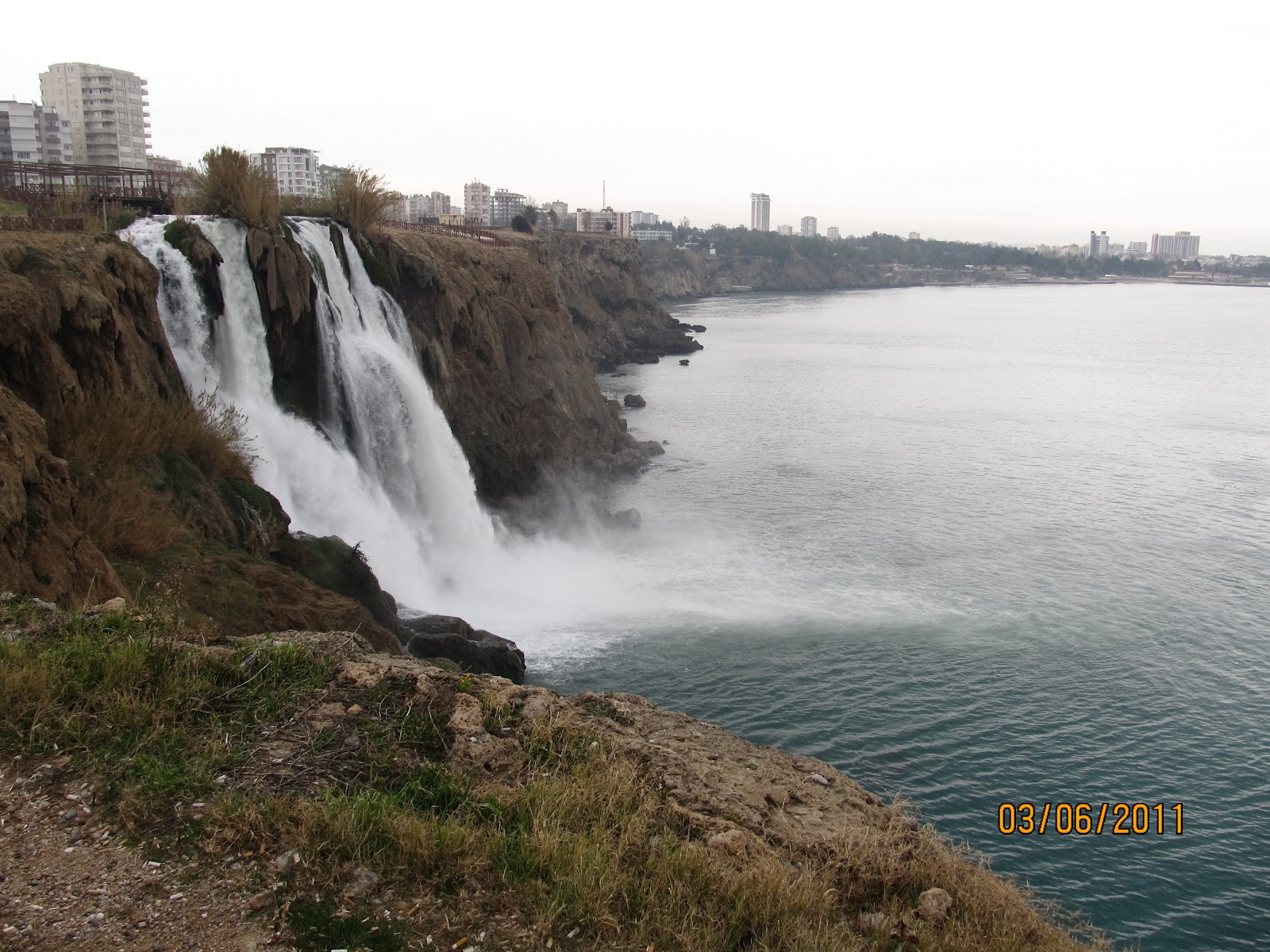 |
| My first glimpse of the |
Mediterranean
 |
| My new favorite word is Agora! |
 |
| Possibly my favorite place we visited: theater at Aspendos |
 |
| Bodrum Castle by the Mediterranean |
 |
| Appolo's temple |
 |
| Church of St. Nicholas
Of course the tour was amazing, but my favorite part of my winter break was the five days I spent at my friend Jane's home in Istanbul. I had a good time shopping, seeing movies, and going paintballing! (my computer says that's not a word) However, it didn't matter what we did. As long as we were together (Me, Jane and her host brother) we were having a good time. those crazy kids even made bus rides fun!
The highlight of the whole trip for me was the last day. I wanted to see the Grand Bazaar and Jane's host Mom wanted a special type of coffee so we went to one of the more touristy parts of Istanbul. At first it wasn't so much fun. We went to the most crowded square I've ever been to... I won't even try to explain how crowded it was. Despite all difficulties we got the coffee and walked to Sultan Ahmet square. Jane's host brother bought everyone salep and we watched the sun set. It was suggested we visit Sultan Ahmet Cami (The Blue Mosque). I wasn't that excited. The first time I went there it had been very hot adn crowded and we were rushed through. I also felt strange going in to a working mosque as a tourist.
This time, however was completely different. The minarets were lighted up for the evening and the atmosphere around the mosque was very calm. Unlike last time, there was no line to get in and there was no hurry as we took off our shoes and Jane and I put on blue headscarves given away at the entrance. Once inside we looked around and took pictures, but we didn't want to leave. "Let's sit down" Furkan suggested. so we all sat in silence and admired the beautiful blue tiled ceiling the mosque was named after.

We ended up talking about religion (you couldn't have chosen a better back drop) and I left the mosque feeling this was an excellent end to an excellent winter break.
|
Friday, January 20, 2012
And I'm off!... almost. In less then 24 hours Ill be taking my first bus on the way to about 10 days of not worrying about real life. It's vacation time, when exchange students get together to check out the more "touristy" parts of Turkey.
It always blows me away how much history Turkey has lying around. Reading a history of Turkey is like reading about all the most important events in the ancient world. Civilization got it's start in Turkey. Greeks and Persians clashed in Turkey. Alexander the Great, Mark Antony, and Julius Caesar all visited Turkey, and made their mark in one form or another. Some of the first Christians were converted here, and of course you cant forget the Ottoman Empire. Then there are the things that might have happened. Mount Ararat is a possible resting place of Noah's Ark. Could the battle of Troy have happened here? There was certainly a King Midas (more than one!) in Turkey, could he have had a golden touch? Many people believe the virgin Mary was brought here by the apostle John after Jesus's crucifixion.
Basically the country is swimming in historical sights. I couldn't hope to visit them all. but Ill get some of the major ones out of the way on this trip.
However as I'm packing I can't help feel some sadnes, because in not very long Ill be packing up this bag again to change families, then Ill pack it up again when I have to leave. I have only cried once since I've been in Turkey, but the idea of leaving my host family brings tears to my eyes. I've had a lot of great memories here and gained some new sisters along the way (can't have to many of those!) It almost doesn't seem fair that I have to leave this second family.
Despite my fears, I know this is what exchange is all about. Leaving behind your comfort zone and being forced to discover who you are.
I'm leaving behind a loving family. I don't know where I'm going. I don't know who I'm going with or if I'll like it there. Hmmmm.... this sounds familiar. That's right I did this same thing almost five months ago. So, Ill save my tears, and get ready for my next adventure. Right now that adventure is a hodge-podge of historical cities around the Agean. In a few weeks or a month it'll be a new family, and in six months it will be to Eagle River, Alaska.
I guess this is kind of check out. Ill be enjoying my next adventure blog free, but I'll let you know how it goes. Check back in two weeks for the next installment, I'm off!
It always blows me away how much history Turkey has lying around. Reading a history of Turkey is like reading about all the most important events in the ancient world. Civilization got it's start in Turkey. Greeks and Persians clashed in Turkey. Alexander the Great, Mark Antony, and Julius Caesar all visited Turkey, and made their mark in one form or another. Some of the first Christians were converted here, and of course you cant forget the Ottoman Empire. Then there are the things that might have happened. Mount Ararat is a possible resting place of Noah's Ark. Could the battle of Troy have happened here? There was certainly a King Midas (more than one!) in Turkey, could he have had a golden touch? Many people believe the virgin Mary was brought here by the apostle John after Jesus's crucifixion.
Basically the country is swimming in historical sights. I couldn't hope to visit them all. but Ill get some of the major ones out of the way on this trip.
However as I'm packing I can't help feel some sadnes, because in not very long Ill be packing up this bag again to change families, then Ill pack it up again when I have to leave. I have only cried once since I've been in Turkey, but the idea of leaving my host family brings tears to my eyes. I've had a lot of great memories here and gained some new sisters along the way (can't have to many of those!) It almost doesn't seem fair that I have to leave this second family.
Despite my fears, I know this is what exchange is all about. Leaving behind your comfort zone and being forced to discover who you are.
I'm leaving behind a loving family. I don't know where I'm going. I don't know who I'm going with or if I'll like it there. Hmmmm.... this sounds familiar. That's right I did this same thing almost five months ago. So, Ill save my tears, and get ready for my next adventure. Right now that adventure is a hodge-podge of historical cities around the Agean. In a few weeks or a month it'll be a new family, and in six months it will be to Eagle River, Alaska.
I guess this is kind of check out. Ill be enjoying my next adventure blog free, but I'll let you know how it goes. Check back in two weeks for the next installment, I'm off!
Sunday, January 8, 2012
Even in America, I wouldn't exactly have called myself "good with kids"
However, As the oldest of three, I pretty much got the basics down. Kids need to be fed, watered, and you can't let them kill themselves or other people. You get extra points if they don't break anything.
These skills were all I needed to to hold down a regular babysitting job for two years or so, and had a few other engagements on the side (okay, more like two)
However, Despite my stunning credentials, I was no where near prepared to handle the children of Turkey
All it takes is a cursarary google search to learn about the legend that is Turkish parenting. Any discipline before five is basically considered child abuse, and Turkish children have collectively earned the title of "little sultan". In my opinion, it's well deserved.
Watching me interact with my host nephews, my family has come to the conclusion that I'm just not good with kids. As Karem and Irfan scream, tackle each other and destruct the house I just stare, overwhelmed. My host sisters didn't try to hide their surprise when they learned people in America actually trusted me alone with their offspring.
"Wow, you can take care of children?" Tuba asks
"I can take care of American children," I correct her. I'm only a little sarcastic
"What, you mean my children aren't angels?" Merve teases
"uhhhh..."
After asking what I was payed in America, Merve says she could pay me to babysit Karem and Irfan. I couldn't tell if she was kidding.
I politely refused "Oh, I couldn't take that away from Asli...." Apparantly, what they got out of that is that I didn't want to be payed to babysit.
One day, all of the responsible adults of the household had things to do, leaving my host father and me to look after Karem and Irfan. My host mother seemed worried, but nonethess, she locked the four of us in the living room with the tv and wished us luck.
This arrangement worked for approximately four minutes. That's how long it took Karem to figure out how to unlock the door. He hightailed it to the kitchen and I followed apprehensively. Irfan toddled behind as I pictured the scene of destruction the rest of the family would come home to in a few hours. I cringed as Karem opened the refriderator and said something in Turkish.
"Oh, mercy, God perserve us" I thought, until I realised the kid just wanted to make orange juice. of all of the crazy things I've had kids suggest while I'm on duty, this was probably one the tamest. In short, I was happy to oblige.
I hauled the orange juice press to the counter and held Irfan on my hip while I sliced oranges for Karem to press into the colorful mug he had helped to pick out. At one point, the other reluctant baby sitter came in to make sure any damage we were inflicting on his house was reparable. I think he was pleasantly surprised.
After the mug was full, I let him squeeze a few more oranges into another cup, until I put my foot down. Surprisingly, he stopped without any screaming, crying, or throwing. However, he did not actually want to drink the orange juice.
That was fine, "more for me" I thought. Karem led us to the hallway where we played spies. (this is played by hushing each other and watching my host father sleep). Once this got boring we moved on to playing dinosaurs. Well really, I played dinasour while Karem played "kid scared by dinosaur" and then "kid comforting crying dinosaur."
eventually all the running and acting practice got tiring and Karem snuggled up in bed with his gameboy (Do kids these days still call them gameboys). Since Irfan had plopped himself infront of the tv somewhere in between "spies" and "dinosaurs", I fell onto the couch surprised at my luck, in a few shorts minutes the resposible adults arrived, valiantly atttempting to hide their surprise at my apparent success.
"Did you have any problems?" Merve asked
"oh, no" I replied
"It was just boring?"
"It wasn't bad."
I decided the fun we had was, perhaps, best kept a secret between me and the boys. After all, I wouldn't want anyone to think I was good with kids.
Monday, December 26, 2011
Totally Different from New Years
In my opinion, it's a common misconception among Turks that they celebrate Christmas. More than once, I've brought up Christmas and gotten the response "We celebrate Christmas on the 31st"No, you don't celebrate Christmas on the 31st, you celebrate New Years on the 31st. New Years is also celebrated in the USA, and (altering a line borrowed from "The Latke who Wouldn't Stop Screaming") Christmas and New Years are two completely different things!
Now that I have that little rant out of the way, it should be mentioned that I have been incredibly blessed with all of the positive interactions Ive had with people regarding Christmas. I received my first present about a week ago from my host sister's future father in law, who found me a large blow up Santa with a squeaking left foot to help me get in the Christmas spirit.
Ive had more than one person ask me when Christmas is, and I have been wished countless "Merry Christmas" es fromm people, from my classmates to my Islamic Religion teacher, who don't even celebrate Christmas.
Anyone who has visited Turkey (especially Istanbul) this time of year can attest to the abundance of Christmas (in fact they are celebrating New years) decorations in streets and stores. I've even seen a few "Merry Christmas" es (in English) from chain stores sporting the same decorations in all their stores throughout the world.
In summary, there is no lack of Christmas (New Years!) spirit this time of year. While there is no specific observance for Christmas day itself, the people of Turkey have not forgotten that there's was the country where the fabled Santa Clause (St. Nicholas) actually existed all those years ago. Also, no Turkish person would turn down an excuse to be festive.
My Christmas started the day before with my journey to Istanbul to celebrate Christmas Eve with the other exchange students there.
Anyone well acquainted with me knows that me traveling by myself through one of the biggest cities in the world cannot be without an interesting story or two. I will not write a play-by-play here, but I will say it involved me handing my phone to a complete (and confused) stranger so that she could confirm to my counselor that I was in the right place. It also involved me missing my bus stop, ending up the only person on the bus, and asking the bus driver to turn around and bring me back to the right stop, which he did. I am eternally grateful to the helpfulness, friendliness, and hospitality of the Turkish people.
Anyways, I made it to Taksim no worse for ware and, after gathering the other exchange students we made a loud multi-national parade to the restaurant where we were celebrating.
I
n one word, the restaurant could be described as "touristy". The only Turkish people there were the entertainers and the few rotexes that had brought us. The rest of the patrons were an eclectic mix representing Korea, Bahrain, Italy, and Singapore among others.
Our agenda that night included watching Turkish dancers, flame and sword throwers; and belly dancers with costumes taken straight from Hollywood.
At the end of the night, everyone was invited on stage for a few minutes of dancing. The South Americans proved that no one else can compete when it comes to having a good time, but the rest of us tried valiantly, and no one was ready to stop when it was time to go home.
Christmas day was, in comparison much less eventful for me, I spent the morning with the family who hosted me in Istanbul. They were kind enough to put me right on the bus to Edirne, so there are not interesting stories about how I got home.
Tuesday, November 15, 2011
Being Included
"Do you have any prayers for the road?" My host father asked me as he started the car
"Yes," I answered "I already said them"
"Your prayers are very fast" said one of my host sisters, gesturing toward her mother and Esra. They were still using their hands to count their prayers, moving their thumbs from finger to finger as they finished each.
The above is just one example of many traditions. I got to observe many more family, religious, and national traditions during my family's trip to Samsun for Bayram
I ran into one of my first traditions on a pit stop between my home in Edirne and Samsun. This came to me in the form of a pink towel given to me by my host mother's mother, Ilhame teyze. After I accepted,I thanked her and kissed her on both sides of the face. Looking up, I realised my host father was trying to get my attention. Curiously, I watched his charades until I realised he was reminding me of an important part of accepting a gift from an older person. I quickly rectified my mistake by taking Ilhame's hand and kissing it, then touching it to my forehead.
I left feeling gratefuland happy, but I didn't understand the significance of what had happened until I was back in the car with Tuba.
"My Grandmother got you a chaste gift?" asked Tuba, clearly amused.
"Well, she gave me a towel" I answered
"That's a chaste gift" Tuba explained "It's meant to be used only after you are married. Older women like to give girls little things like towels and blankets in chaste."
Usually, I would fined something like "chaste gifts" a big jump out of my comfort zone, but under the circumstances it seemed very thoughtful, a genuine attempt to include me in Turkey's culture.
Since we were at my sister's for Bayram, I also got to witness bayram-specific traditions
The first traition I participated in was dressing up. For the first day, I borrowed a dress from Tuba, who also did my hair and nails.
Next was the kissing part, which I didn't particularly enjoy, but it was followed by the recieiving of money, which I didn't mind at all.
In more detail, Turkish children are supposed to kiss the hand of an older relative, put the hand to their forehead, and say "iyi bayramlar". In return, the relative will give the child money. In my family at least, you are considered a child until you are married, or even longer!
Another important Bayram tradition is visiting. During Bayram, it's assumedthat guests will come unannounced, and they will be expecting a feast!
The influx of guests meant I was exposed to even more traditions, especially religious. One visit sticks out in my mind where a more conservative muslim family came to visit, and we arranged two rooms to entertain them, one for the men and one for the women. The oldest woman had come in a burka, and only took it off once we were in a room with only women.
Luckily, the tradition of visiting goes both ways, meaning that we were able to pop in on any number of turkish families, and that meant we were fed a lot. Baklava and tea were the main feature on every menu, but I also got to try borek, dolmus, and homemade grape juice among other things.
The final tradition I will mention is one that is particular to my family. It involves the youngest girl in the fmaily going around and giving everyone in the family hand sanitiser. Since I'm the youngest girl in the family, I got the honor. Yes, it did occur to me that they mihgt have made that up just to see me running around offering family members hand sanitiser. It was fun regardless.
I was very greatful to exerience all of these traditions in such a short space of time! I hope there are many more to come.
Wednesday, November 9, 2011
A Samsun we a'go
"What's that?" I asked my host sister, Tuba as she unloaded three bags of cheese from the other car."More cheese" Tuba answered
"Oh, good, I was just thinking we didn't have enough cheese."
"You'll be surprised" was her response to my sarcasm.
We were packing up for the family's road trip to Samsun, and I'm pretty sure the last thing we needed was another bag of cheese. Despite my personal feelings, however, I helped stuff over half of the trunk with the special white cheese found only in Edirne, and then filled the other half with our personal belongings.
After kissing Asli (she had to stay behind to study) and the maid goodbye. My host father started the car, and we were off. Our first stop was going to be in Istanbul, to spend the night at my host sister's apartment.
As it turns out, the term "apartment" only very loosely describes the place we spent the night in. In my experience, all Turkish dwellings are pretty nice, but Esra's was more like a palace, or a page out of a high end furiture catalog.
However, the power was out at Esra's place, so we went to spend the evening at her in-law's apartment, which was, if possible, even nicer. The living room was gold-themed, meaning that everything but the tv was gold: gold rugs, gold tablecloths, gold glasses in the gold cabinet. Sitting on gold couches we were served Turkish coffee from gold coffee cups.
Before we came, Esra's in-laws had already been expecting guests, so after a bit of rest. I went with the other young women to the kitchen to prepeare for the other guests. I mostly watched as unbeilevable amounts of assorted baklava was arranged on plates and tea and coffee was prepared. Guests began to arrive and everytime the doorbell rang, we would emerge from the kitchen to greet them. I quickly became used to the routine.
When it was time to serve the food, I followed shyly behind Tuba, carrying two plates of baklava. Finding the guests rather intimidating, I attempted to slip in and out unnoticed, but it wasn't to be. A few minutes later I was informed that they wanted to see me again.
"Do you want me to come with you?" Tuba asked, kindly.
"That's alright" I replied "I'm fine." Bravely, I made my way back to the room where several women in headscarves were sitting. I put on my exchange student smile and attmepted to answer a bunch of questions in Turkish.
Afterwards, I came back to the kitchen, where Tuba congratulated me on my survival. "I thought they were going to eat you alive" she admitted.
In the kitchen, we enjoyed baklava, then I helped make fruit salad.
Overall, My evening in Istanbul was a very nice experiece. I spent the night with Tuba on Esra's couch, and we woke up early the next morning ready for our last leg to Samsun.
Saturday, October 29, 2011
It's the Little Things
Trying to be a good exchange student
In my pre-exchange days, it seems like countless things determined my worth: grades, fitness, after school activites, relationships.... the list could go on into ifinity. Now, sometimes it feels like there are only two things that matter: Turkish and my social life. This isn't really bad thing, as long as my Turkish and social life are going alright, and usually they are; yesterday, though, it felt like I hit a wall.
The 28th and 29th of October mark Turkey's republic day, which means no school on Friday. That, on top of my host parents going to Istanbul sounds like it could be a lot of fun. The only problem was I didn't have an invitation to do anything.
"You should ask your friends to go to the cinema" my host sister suggested. This sounded like a good idea, except for my lacking Turkish skills. Sure, I could type out. "Do you want to go the cinema today?" in Turkish but the logistics of plannning a time and place to meet seemed beyond my reach.
Nevertheless, I tried the one number I had in my phonebook, and after initial pleasantries I texted "Do you want to go to the cinema?" (in Turkish) After an agonisingly long wait I learned she couldn't go.
Next, I turned to Facebook, where I messaged a few of my friends, but nothing seemed to work out. I was about ready to give up, and what was worse, I couldn't even communicate in Turkish by myself. I frequently had to turn to the evils of Google translate. I felt like a complete failure, I couldn't do the only two things that seemed important.
Frustrated, I went back to the kitchen to study. Apparently I let my mind wander, though, because I began to think.
What makes a good exchange student? Is it how many people she hangs out with after school? How many words of Turkish she learns? What about all of the conversations I've had with people comparing cultures? What about all the misconceptions I've cleared up about Alaska, or eyes I've opened to Turkey through my blog and Facebook posts? What about all of those little moments where I've felt happy and accepted here? One recent moment stuck out in my mind particularly.
I was studying with my host sisters in my room when I heard my host father calling out something from downstairs. Usually, if I don't understand what's being said, I assume it's not about me, but as it turns out, this time it was.
"He wants to show you something, probably on TV." The oldest sister, Tuba, explained in a voice that clearly implied I didn't have to if I wasn't interested.
I was bored of studying anyways, so I headed downstairs to the living room where my host parents had the TV on. "It's the American Champion" My host father told me. I didn't understand what he meant until I saw what he had on. Figure Skating!
For another person this might not have been a big deal, but I considered this small gesture incredibly thoughtful. For one thing, it showed he remembered me telling him about my past in ice skating. For another thing, it reminded me of something my own father would do, although with him I'd probably roll my eyes and act like I wasn't interested.
There have been countless little moments like these. I still remember the time I taught my classmates how to waltz in exchange for lessons in traditional Turkish dance, and the time we had an impromptu Turkish dance performance in front of my math class. There was the time my friend offered to teach me all the "bad" words in Turkish, and all the times Vahide said I was allergic to alcohol so her friends would stop insisting I try some. There was the feeling I got when the president of my rotary club told someone I was his daughter, and the moment I realized "family" is more than biology. There was just yesterday when my host sister taught me how to make borek, and countless times when one of my english-speaking friends would wonder how my closest friends were girls who didn't speak english. I try to explain, but I really can't describe these bonds that go deeper than words.
So maybe it doesn't matter that I didn't have anything to do one friday, or even a whole weekend. I can stay home and try to improve my Turkish, and I can talk with my host family and cherish the little things.
Subscribe to:
Posts (Atom)